


A child that seems to have a surplus of energy; he or she is always running, climbing, jumping, seems unable to wait his turn and she tends to talk at an exhaustive speed with a flurry of ideas. The problem with sensitivity to this symptom is that it is very difficult to discern the observed behaviour from that of a perfectly normal child.
This is especially true for children younger than six years old where activity levels and expressive qualities are still developing and what is “normal” can be very much subject to interpretation.
Recognising ADHD
An ADHD diagnosis requires the symptoms that a child displays to be at odds with the characteristics associated with a child’s age and developmental level. As every child is different and because it is very easy to make comparisons amongst the children you encounter in your social circle, it is in a parent’s best interest to not try to diagnose their own (or someone else’s!) child based on personal observations. The same is true for teachers!
Although a teacher, especially an experienced one, may be able to identify behaviour which stands out from the norm and convey the observed behaviour to parents, one cannot take a teacher’s observation at face value. A teacher plays a vital role in the diagnostic process, but is not a diagnostic expert. Many children may only begin to show definite signs of ADHD at school-going age due to the more structured environment requiring behaviour to be regulated in a way that a hyperactive child struggles to or because an inattentive child is having difficulty keeping up with the rest of his/her peers.
It is important to align a teacher’s observations with what you observe at home, as well as asking him/her about your child’s social interactions. Aside from possibly being fidgety at one’s desk, regularly speaking out of turn or staring into space instead of working, does your child generally get along with his/her classmates? Is he a bit of a bully? Is she quiet and withdrawn while the other children are playing? Is she fighting (verbally and/or physically) with other children? Is he too boisterous to play well with the other children? Take this information and consider whether or not some of these social and behavioural aspects are apparent at home – fighting with siblings or parents, seeming to ignore requests, unable keep up with chores, regularly falling or hurting himself or playing in a manner which does not show concern for injury or consequence. If this is the kind of behaviour that you are observing, it might be time to verify if your suspicions are correct with a suitably qualified health care professional such as a paediatrician or child psychologist. Please note that your General Practitioner, although a convenient first point of contact, might be good for a preliminary examination, she/he should not be the one making a final diagnosis.
The diagnostic procedure
When consulting with a diagnostic specialist, the guidelines most commonly applied are those provided in the Diagnostic and Statistical Manual of Mental Disorders (DSM) or the International Classification of Diseases. These guidelines are very similar, but do differ in terms of the condition name and some of the applied criteria. While the fifth edition of the DSM was published in May of 2013, the new ICD guidelines are only expected to be published in 2017, thus the DSM-5 guidelines are currently the most up-to-date diagnostic criteria.
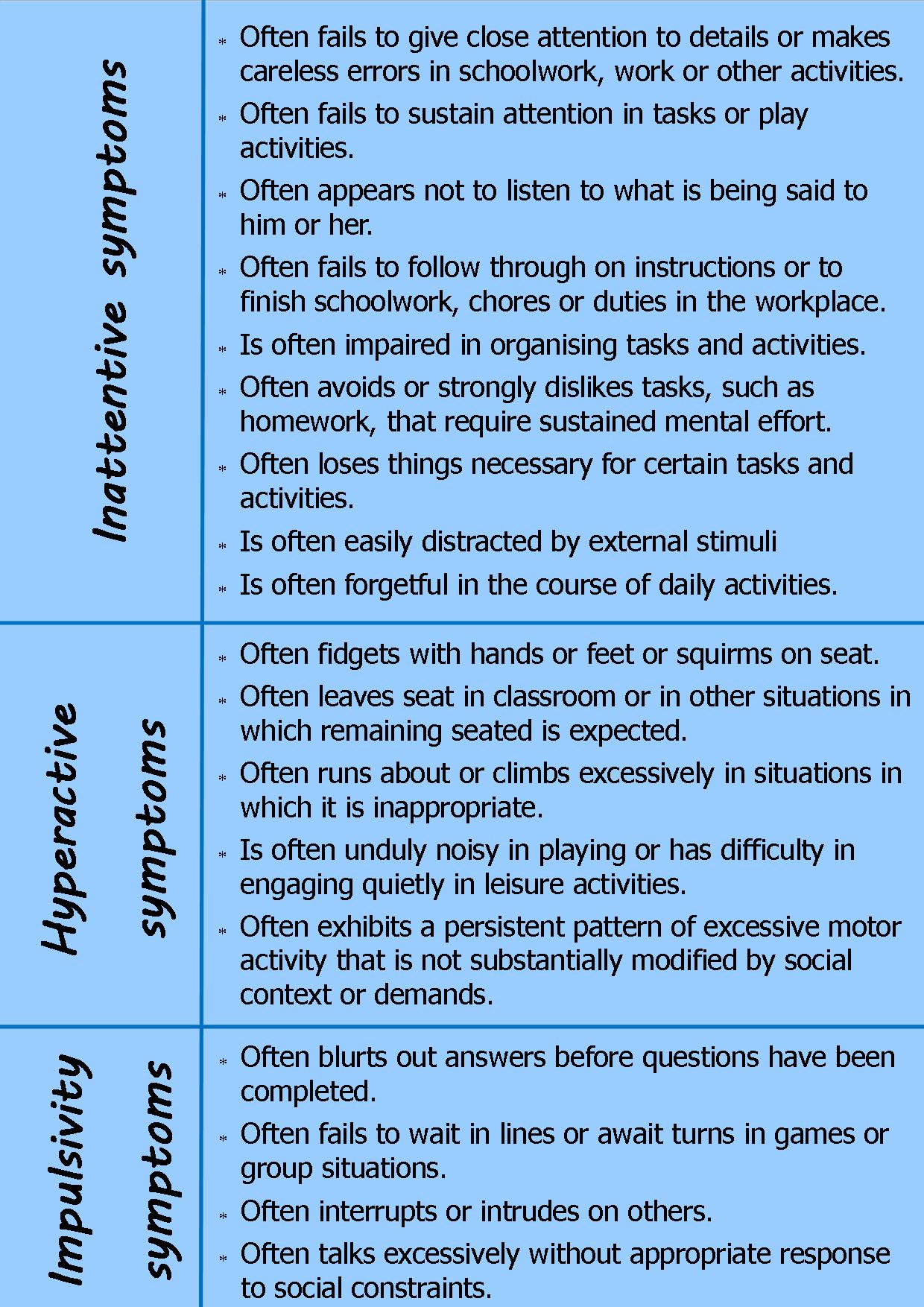
ADHD is classified into three different subtypes: predominantly hyperactive/impulsive, inattentive or combined. ADHD is referred to as “Hyperkinetic Disorder” according to ICD-10, with the primary difference between the two guidelines being the fact that ICD-10 only recognises the “combined subtype”.
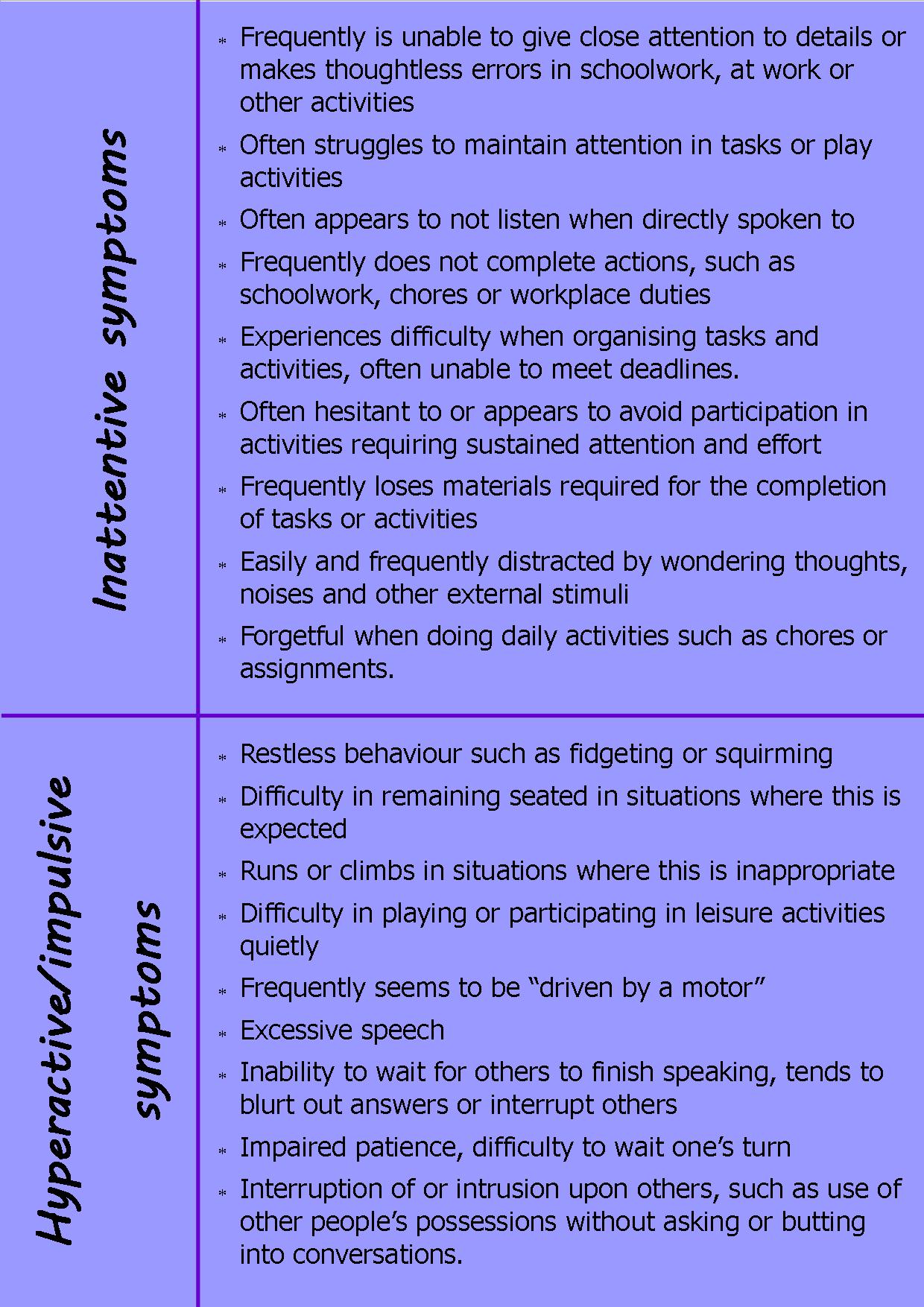
The application of these guidelines requires that a specified number of symptoms (listed in the accompanying figures) are experienced for a period of at least six months in at least two different settings (such as at home or at school). It is important that the experience of these symptoms results in impairment, as in these is a definite difficulty as a result of their presence. Although a positive ADHD diagnosis previously required for symptoms to have been present before the age of seven years, the DSM-5 has changed this criterion to 12 years of age. There are many reasons for this, but one that stands out is the fact that some symptoms, inattentive ones in particular, may only become apparent as a child grows up and is expected to be capable of managing a wider array of tasks and activities.
Depending on the specialist consulted, a variety of other assessment tools may be used to supplement these primary guidelines. These include teacher rating scales, parent and child interviews, general psychological and physical examinations, adequate medical history taking and possible vision, hearing and language assessments.
After the diagnosis
If you have not taken the appropriate steps, it might be in your best interests to seek a second opinion on the diagnosis to confirm that it is accurate. However, even if you have gone through the appropriate steps, you may still feel unsettled and worried. No parent likes to feel that there is something “wrong” with his/her child. And with the stigma attached to ADHD, it is easy to adopt an attitude of denial. Sometimes it helps to try looking at the condition from a different perspective. If your child needed glasses due to an astigmatism or being near-sighted, would you blame yourself or possibly deny him or her the glasses that he or she needs to be able to see world clearly? Doubtful. Try to remember that the treatments, both psychological and pharmaceutical, are there to help your child’s brain process information in a way that is considered normal. As a parent, your attitude has a huge influence on your child’s self-esteem and if you treat him or her as if they are abnormal, it will only worsen the feelings of isolation or rejection that he/she is probably already experiencing as a result of poor peer relations. Educate and empower yourself so that you can be the best support system possible for your child. – Judith Regnart
Author Bio:
Judith is a wife, pharmacist, part-time PhD student, bellydancer and mother to three furry children. Although she hopes to start her own family in the near future, in the mean time she devotes her faculties to researching aspects of ADHD in the hope of positively contributing to understanding of the disorder. She has real life experience with her late-life ADHD diagnosed husband who is living proof that a difficult childhood of undiagnosed ADHD can be overcome and can be very rewarding creatively as evidenced by his photography business, www.nikregnart.com.
Consulted references:
American Psychiatric Association. 2013. Diagnostic and Statistical Manual of Mental Disorders. Fifth Edition. Arlington, VA: American Psychiatric Association. 947 pp; National clinical practice guideline number 72. 2009. Attention deficit hyperactivity disorder: diagnosis and management of ADHD in children, young people and adults. National Collaborating Centre for Mental Health. Great Britain: The British Psychological Society and The Royal College of Psychiatrists. 662pp.
*This article is copyrighted. You are welcome to share it, without altering the contents, giving proper credit to the author and link to this article. All views expressed in articles are that of the person being interviewed. Please consult your care giver for professional advice on your birth choice.
{jcomments on}